
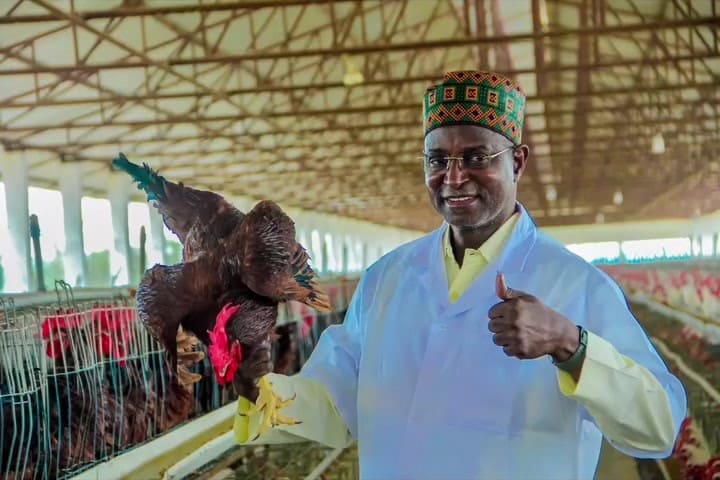
The decision by the administration of President Bola Ahmed Tinubu,GCFR, to establish the Federal Ministry of Livestock development was widely welcomed by agricultural stakeholders, investors and rural development experts across the country.
For decades, Nigeria’s livestock sector has operated far below its real economic potential. Despite the country possessing one of the largest livestock populations in Africa, the industry has remained fragmented, undercapitalized and largely informal.
The creation of a dedicated ministry therefore signaled a long-overdue recognition that livestock production is not merely a traditional occupation but a serious economic enterprise capable of driving national development.
Yet several months after the ministry’s creation, it appears unable to fully commence operations due largely to limited funding and the absence of critical operational structures. While a minister, Alhaji Idi Mukhtar Maiha, has been appointed, the ministry is yet to take off in a manner that reflects the urgency and promise behind its establishment.
This is a development that deserves urgent attention, because the delay risks slowing the momentum generated by what is otherwise one of the most visionary policy decisions in Nigeria’s recent agricultural history.
As an agricultural consultant with global experience spanning more than three decades in agribusiness and livestock economics, I strongly believe that the establishment of this ministry represents a strategic turning point for Nigeria.
Around the world, countries that deliberately invested in livestock development have built thriving industries that generate employment, stimulate rural economies and contribute significantly to national income. Nigeria has all the natural and economic conditions to achieve the same results if the sector is properly structured and supported.
Nigeria’s livestock economy is vast but largely untapped. The country is home to millions of cattle, goats, sheep and poultry, alongside expanding opportunities in piggery, aquaculture and dairy production. Yet Nigeria continues to import large quantities of dairy products and animal protein that could otherwise be produced domestically. With the right institutional support, livestock development alone could become one of the strongest pillars of Nigeria’s economic diversification agenda.
The opportunities within the sector are immense. Nigeria has the capacity to develop a robust dairy industry that significantly reduces the country’s dependence on imported milk while providing sustainable income for rural communities. With improved cattle breeds, organized pasture development, efficient cold-chain systems and modern dairy processing facilities, local milk production could increase dramatically.
Equally important is the transition toward modern ranching systems. Structured ranching would improve livestock productivity, strengthen animal health management and create stable commercial livestock enterprises. Just as significantly, it would address one of Nigeria’s most persistent rural challenges: the conflicts between farmers and herders that are often triggered by uncontrolled open grazing. By promoting ranch development, grazing reserves and feedlot systems, Nigeria can modernize livestock production while reducing competition over land and water resources.
There are also significant prospects in meat processing and export. At present, Nigeria’s meat industry operates largely within informal markets with minimal processing infrastructure. With modern abattoirs, hygienic processing facilities and export-standard quality assurance systems, Nigeria could develop a competitive meat industry capable of serving both domestic and international markets.
The leather and hide value chain also offers considerable promise. Nigeria already produces substantial quantities of hides and skins used in leather production. With proper processing infrastructure and industrial linkages, the livestock sector could become a major supplier to the leather industry while boosting exports and creating manufacturing jobs.
The poultry industry, which already plays a vital role in Nigeria’s food supply, has the potential to expand even further with improved feed production systems, stronger veterinary services and better hatchery infrastructure. Similarly, sheep and goat production—well suited to Nigeria’s ecological conditions—offers enormous opportunities for small-scale commercial farming and rural household income generation.
Collectively, these livestock value chains represent millions of potential jobs across farming, veterinary services, feed production, logistics, processing and retail distribution. Few sectors offer such a broad and inclusive economic impact.
However, unlocking these opportunities requires strong institutional leadership, clear policies and sustained investment. This is precisely why the establishment of the is so important. A dedicated ministry provides the policy focus and coordination needed to transform livestock from a largely subsistence activity into a structured national industry.
But creating a ministry without providing it with the financial resources required to function risks undermining the very vision behind its establishment. The early phase of any new institution is critical for developing policy frameworks, launching pilot projects, coordinating with state governments and attracting private sector investment. Without adequate funding, the ministry cannot effectively develop national livestock strategies, strengthen veterinary systems, support breed improvement programs or facilitate the infrastructure needed for modern livestock production.
Nigeria cannot afford to delay action in a sector with such enormous economic and social implications. Livestock development has the potential not only to strengthen food security but also to reduce rural poverty, create employment and support the broader objective of economic diversification.
President Tinubu has already demonstrated commendable foresight by approving the creation of the ministry. What is now required is the commitment to ensure that the ministry receives the necessary financial and institutional support to begin its work in earnest.
Investment in livestock development should not be viewed as a cost but as a strategic national investment capable of generating long-term economic returns. The Federal Government must therefore move swiftly to provide the funding and operational support that will enable the ministry to fully take off.
At the same time, the Nigerian public, private investors, development partners and state governments must rally behind this initiative. Livestock development is not merely a government program; it is a national economic opportunity whose benefits will extend across the entire country.
The vision behind the ministry is sound and timely. The opportunities within the livestock sector are enormous. What remains now is to ensure that this bold initiative is not allowed to stall but is instead given the support required to succeed.
Olufemi A. Adetola, an Agricultural Consultant and a Farmer, writes from Ago-Are, ATISBO LGA of Oyo State